History
WIKF Northern Ireland traces its lineage from Hironori Ohtsuka Sensei through Tatsuo Suzuki Sensei and the Wado International Karate-Do Federation.
Hironori Ohtsuka
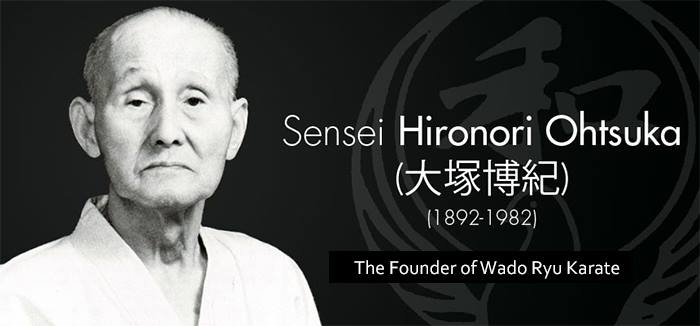
Ohtsuka Sensei was born in 1892 in Shimodate, Ibaraki, Japan. He began training in Shindo Yoshin-ryu jujutsu as a child under Tatsusaburo Nakayama, and in 1921 received full transmission of that school — recognition that came years before he ever practised karate. His grounding in jujutsu would shape everything that followed.
In 1922 Ohtsuka Sensei began studying karate under Gichin Funakoshi, the Okinawan master who had recently brought karate to mainland Japan. He also trained with other senior teachers of the period, including Choki Motobu and Kenwa Mabuni. Over the next decade Ohtsuka Sensei worked to combine what he had learned in karate with the principles of his original jujutsu training.
The result was a style with a distinct character. Where Funakoshi’s karate emphasised strong stances and direct techniques, Ohtsuka Sensei introduced body shifting (taisabaki), evasion, joint locks, throws, and a softer approach to receiving attacks — principles drawn directly from jujutsu. He also placed greater emphasis on free sparring and pre-arranged pair work as essential parts of training. Where other karate styles tend to meet force with force, Wado-ryu emphasises timing, distance, and redirecting attacks rather than absorbing them.
In 1938 Ohtsuka Sensei formally registered his style with the Dai Nippon Butoku Kai, the official Japanese martial arts body, and in 1940 the name Wado-ryu — 和道流, “the way of harmony” — was officially accepted. The name itself reflects Ohtsuka Sensei’s view of karate: not as an aggressive system, but as a discipline grounded in harmony, timing, and yielding rather than confrontation.
Recognition followed throughout his lifetime. He was appointed Chief Karate Instructor for Japan in 1944, awarded the Order of the Rising Sun by Emperor Hirohito in 1966, and later given the title Meijin (10th dan) — the highest recognition in Japanese martial arts. He continued to teach and supervise the development of Wado-ryu until his death on 29 January 1982.
Tatsuo Suzuki
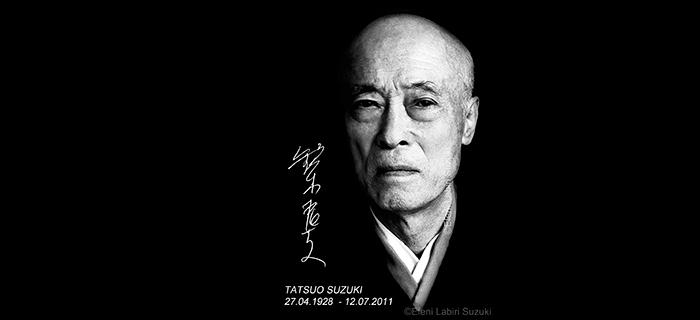
Tatsuo Suzuki Sensei was born in Yokohama in 1928 and began karate training as a teenager. From 1945 to 1956 he trained directly under Ohtsuka Sensei at Wado-ryu headquarters — the formative years of his martial arts career.
He earned a reputation early for sharp technique and serious training. In 1951 he was awarded 5th Dan, which WIKF sources describe as the highest Wado grade at that time. He went on to travel and teach alongside Ohtsuka Sensei, and became one of the key figures in bringing Wado-ryu outside Japan.
From 1956 onwards Suzuki Sensei established the first Wado federation in England and used London as a base for teaching across Europe. That work mattered enormously. Through courses, demonstrations, and hands-on instructor training, he helped make Wado-ryu one of the most widely practised karate styles in Europe.
Students who trained under Suzuki Sensei remembered his speed and technical clarity, but also his insistence on correct basics, clean movement, and the martial meaning behind the forms. His influence went well beyond organisation — it shaped the way generations of Wado practitioners actually moved and taught.
Why the WIKF Was Created
After Ohtsuka Sensei’s death in 1982, the Wado world became more fragmented. Different groups developed different technical interpretations and organisational loyalties. According to WIKF history, Suzuki Sensei made repeated attempts to reunite those organisations, but the divisions remained.
In 1990 he founded the Wado International Karate-Do Federation (Wado Kokusai Karate-Do Renmei) to preserve Wado-ryu as he had learned it from Ohtsuka Sensei and to keep that teaching consistent across countries.
The WIKF was always more than an administrative body. Shared technical standards, regular contact between senior instructors, and loyalty to the Ohtsuka–Suzuki line of teaching are what hold it together.
In 2008 Suzuki Sensei appointed a World Technical Committee to maintain those standards, and in 2009 he passed the role of World Chief Instructor to Jon Wicks Sensei while remaining Chief Director. Suzuki Sensei died on 12 July 2011. The WIKF continued with the structure he had put in place.
WIKF and Northern Ireland
The local clubs carry that same line of teaching. The syllabus, the emphasis on etiquette and discipline, and the connection between clubs here and the wider federation all come from this history.